Seek First to Understand: How Igniting Curiosity Transformed My Career and Leadership


Some lessons in your career arrive slowly. Others hit hard. This is one of the latter. It is the lesson that changed the trajectory of my sales engineering career, reshaped how I build relationships and fundamentally shifted how I lead.
The Moment Everything Shifted
Very early in my sales engineering career, I had a moment of clarity that changed everything. I remember it vividly. A sales rep and I were walking a customer through a piece of technology we were both passionate about. They asked a fairly simple question, and, as sales engineers often do, I raced to give a technically perfect answer that showcased just how capable the product was.
Later, in the car park, we did a debrief. I felt unsettled. The rep challenged me on something that hit harder than I expected: I had answered the question without fully understanding it. I had not paused to explore the ‘why’ behind it.
That moment lit a fuse for me. The idea of “seeking first to understand before seeking to be understood” stopped being a cliché and became a discipline. My curiosity switched on. I realised it was a much harder habit to build than I thought, both for me and for the brilliant sales engineers and leaders I have worked with since. But once you crack it, it opens up a more genuine, value-based relationship with customers and with the people around you.
If you never slow down enough to understand the question behind the question, you are missing half the conversation. So start by asking yourself why you answer quickly, is it ego? Fear of rejection? A toxic environment? All are valid possibilities, but none are healthy or productive.
How I broke the habit, or at least started to break it, was extremely low-tech. I grabbed a label maker and stuck a strip across the bottom of my laptop screen that read: seek first to understand before seeking to be understood. It stared back at me in every meeting for months. Eventually, it changed how I behaved.

Years later, when I was introduced to frameworks like Command of the Message and other value-selling approaches, I realised they were simply more mature expressions of that early lesson. The fundamentals had always been there.
Why We Rush to Answer
The biggest shift for me was realising that curiosity is not a soft skill. It is a competitive advantage. When you stop trying to impress and start trying to understand, everything changes. You unlock better conversations, better relationships, deeper discovery, sharper positioning and far more accurate technical alignment. Curiosity moves the discussion from performance to partnership.
Asking questions fundamentally changes the narrative. People often think they are asking a question because they want an answer, but the real value sits in the discovery journey that follows. When you engage in a question-driven conversation rather than throwing around disconnected facts, you get to explore the core of the problem. You uncover motivations, fears, constraints and objectives. You start to see where you can genuinely add value, not just where you can respond with a product pitch.
In that early meeting I mentioned, the customer asked whether our product supported a particular backup methodology. I answered immediately with the technical facts. What I should have asked was, “Run me through why that matters for your business.” Or, “How do you handle disaster recovery today?” Or, “Have you had a breach?” Or even, “Do you lie awake at night worrying about data loss?” There were a hundred great questions that would have revealed the real problem set. Instead, I treated his question as a prompt to showcase knowledge, not an opportunity to understand the customers world. The result was technically correct but practically useless. Igniting your curiosity unlocks your ability to engage with people on the things that matter..
Throughout my career, the most meaningful breakthroughs have come from these curiosity-driven conversations. Many times, especially with senior leaders, asking thoughtful questions has uncovered a real problem set that was far more valuable than throwing technology at whatever we initially thought the issue was. The same thing happens inside teams. An employee might ask for something that does not quite make sense on the surface. Instead of saying ‘no’ or jumping straight into solution mode, exploring the ‘why’ together almost always leads to a better outcome because we reach a shared understanding of the context.
This is not just a sales engineering skill. It is a life skill and a leadership skill. The more you build the habit of seeking to understand before you respond, the more genuine value you create in every interaction.
The Mindset Shift
Of course, building this habit was anything but easy, especially given where my career began. My background was in infrastructure management and data centre operations. I ran systems, machines and environments where things either worked or they did not. Everything was grounded in fact. When something broke, there was always a technical cause, so being technically correct felt like the core skill. That mindset served me well in operations, but it made the transition into sales engineering harder, because my instinct was always to answer quickly and precisely.
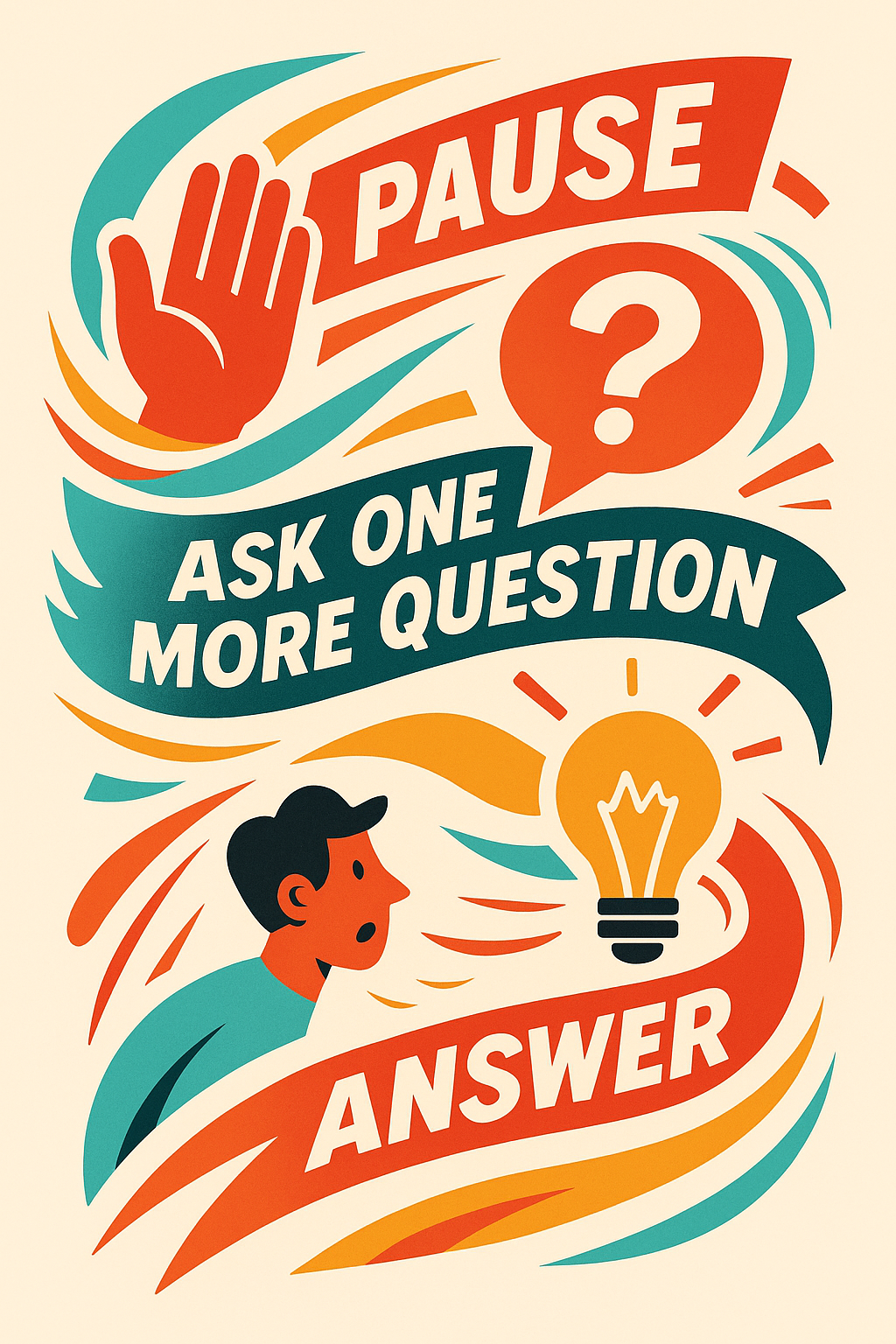
Another way to break the habit is to ask one more question before you answer. When someone asks something, pause, breathe and add a clarifying question. It puts everyone in a better position to understand what the real problem looks like. Practicing and repetition has made curious engagement fairly automatic for me now, it that was something I had to work hard to build.
Early in my career, the pressure I felt to prove I was smart, capable or technically strong was immense. Many of us feel that. That is why I had to pull out the old label maker and put that sticker across the bottom of my laptop. I needed something to force me to pause, even for a couple of seconds. And that pause was enough. It interrupted the reflex to respond and created space to actually think.
The best leaders are not the ones who always have the answer. They are the ones who create a space where the team can explore the problem together and reach the answer collectively. Slowing down that first instinct changes everything. Asking great questions helps you uncover intent rather than just collecting information. People often ask how something works when what really matters is why it happens, or what behaviour they are trying to influence. They ask for features when their actual need is an outcome. So many questions are shaped by previous failures, frustrations or fears, and unless you explore those, you miss the whole point.
And then there is the cost of getting it wrong. When you rush to answer without understanding, the consequences add up. Misalignment increases. Time gets wasted. People feel unheard. The real problem remains hidden. It is incredibly frustrating for everyone involved.
This is why leaders must create an environment where pausing, asking questions and doing proper discovery is encouraged, not seen as a delay. A strong culture is not one where people compete to respond the fastest or list the most technical facts. It is one where people think together, challenge assumptions, understand the situation and arrive at the best path forward.
As a side note, silence is uncomfortable for many people. There is a well-known video of Steve Jobs in the early days of Apple answering a tough question. He pauses for a long time before responding. The room waits, he reflects, and then he gives an outstanding answer. That clip has stuck with me because the pause gave him the space to think, to remove emotion and to formulate a better response. Even saying, “Give me a second to think about that”, is far better than blurting out technical facts just to fill the silence.
The Impact of Curiosity in Practice
This habit of asking questions, conducting real discovery, and creating space for people to understand the situation around them is worth the effort. As I write this, I can think of countless moments where this approach changed the trajectory of an interaction for the better. One example from about six years ago, right in the middle of lockdowns, still stands out.
We were preparing for a meeting with a very senior CISO. I was on the call with a couple of incredibly capable sales engineers from my team. We had technically prepped. We knew the product inside out. We were polished and rehearsed and ready for any deep technical discussion that might come our way. But heading into that meeting, I kept coming back to one thing: I wanted it to be about the customer, not about us. I wanted them to walk away feeling like we understood them, not like we had showcased our expertise.
Despite all the preparation and all the technical firepower in the room, we pivoted early into an expansive discovery session. We asked questions. We dug into the impact of their challenges. We explored why those challenges existed in the first place. And something shifted. We walked out with a deep, shared understanding of their world. They walked out feeling heard, respected and confident that we could support them on their journey.
The follow-up from that was one of the most effective proofs of concept I have ever seen, and, ultimately, a loyal long-term customer. And here is the important part: this CISO was highly technical. They could have easily absorbed a full technical briefing. But the real value came from building a shared plane of knowledge, a common foundation that let us work together to solve a complicated set of problems. The technology mattered, but the trust mattered more.
How to Put This Into Practice
If you want to build this habit yourself, start small:
- Ask one clarifying question before you answer anything.
- Pause for two seconds before responding.
- Look for intent, not just information.
- Explore the question behind the question.
- Do not rush to prove yourself.
Small behaviours compound quickly.
Additional questions you can use
- “What’s driving this concern for you right now?”
- “Can you walk me through what’s happening behind the scenes?”
- “What has already been tried, and what did you learn from it?”
- “What would a successful outcome look like for you?”
- “Who else is affected by this, and how?”
- “What assumptions might be shaping the way you see this?”
- “What would happen if you delayed the decision?”
- “What part of this feels most uncertain or risky?”
- “What is the real constraint you are trying to navigate?”
- “If you could only fix one part of this, which would it be, and why?”
- “What’s the problem behind the problem?”
- “What else should I know so I can give you the most useful answer?”
A Final Thought
My coaching to leaders, sales engineers and anyone in a role that requires collaboration is simple: be curious. Ask great questions. Do not fear the pause. Curiosity strengthens relationships with peers, teams, leaders and customers. Understanding builds trust. And trust is the foundation of every meaningful interaction you will ever have, in work or in life.